Have you used ChatGPT for searches? If you have, you have probably noticed that the entire search experience is changing. Now, we are asking questions and getting answers back in the language and format we are most comfortable with!
We would like to call this entire paradigm shift -> Search 2.0!
What exactly is Search 2.0?
While earlier search was keyword based and delivered tons of blue links that you had to open and review manually to get the content you need, now it is more conversational in nature. You ask AI a question or even better, a series of questions and it answers them all right away.
In simple terms, Search 2.0 is more user friendly, talks to the user in summaries and works a lot like a smart human assistant. Users don’t need to learn its language anymore, it will automatically learn theirs. Not to mention that search can now be based not just on texts but a lot more – screenshots, photos, voice and video.
Phew! Quite the advancement isn’t it?
Traditional Search VS Search 2.0?
A detailed comparison between Traditional Search and Search 2.0 is given below.
| Parameter | Traditional Search | Search 2.0 (AI Based Search) |
| Type of Keywords | Short, exact-match keywords (e.g., “buy shoes online”) | Conversational, intent-driven queries (e.g., “best running shoes for flat feet”) |
| Key Search Result | List of Ranked Blue Links | AI-generated answer summaries with source citations |
| Modes of Search | Mostly Text | Multimodal: text, voice, images, video, screenshots |
| Interaction Style | One-way: user searches, clicks, reads | Conversational: follow-up questions, iterative refinement |
| Ket Success Metric | Click Through rate | Visibility in AI summaries |
| Ranking Factors | Backlinks, keywords, domain authority | Content clarity, structured data, trustworthiness, experience-rich content |
| Role of Content | SEO-optimized for algorithms | AEO-optimized for machines + human readability |
| Featured Snippets | Nice-to-have advantage | Baseline requirement for AI citations |
| User Goal | Find and click a link to learn more | Get an answer directly from the search result |
| Content Format Preference | Longer articles, technical SEO | FAQs, TL;DRs, step-by-step guides, structured formats |
Where is Search 2.0 happening?
Search 2.0 is happening in two places – one in AI based search platforms like ChatGPT and Perplexity and the other in well known search engines as AI overviews.
While AI-first search platforms like ChatGPT and Perplexity still make up a small share of the overall search landscape (about 1–2%), that’s not small in real terms. ChatGPT alone now handles an estimated 37.5 million searches daily. Compare that to Google’s estimated 5 trillion searches in 2024, and you’ll see Google is still king — but challengers are rising. Here is what Gemini says!
Google AI Overviews
During the recently concluded Google I/O 2025, Google announced that it is bringing AI Overviews to a billion users. In short, it is a feature in Google Search that provides concise AI-generated summaries of the search results at the top of the page.
Why is it important?
Google’s announcement is a game changer. Going forward, instead of links, searches will now showcase a smart, AI-generated answer at the top of search results — sourced from the most relevant websites. Including websites like yours.
This is a fundamental change. It changes everything that we used to think about about visibility, traffic, and even conversions. Now, users may never even click to come to your website. But if your content is cited in that answer, you still win.
Given this new arena with search evolving into conversation, context, and synthesized answers, how your content needs to show up is also changing.
What does this mean for business owners?
For businesses, this change is both a challenge and a massive opportunity. The opportunity is to adapt and gain visibility in these new parallel search mediums that did not exist before or to not and quite possibly perish under the weight of search algorithms. Any business, no matter how old or new, can now win in the AI synthesized visibility arena.
Some fundamentals are still the same, but the scales have turned.
For example, unlike what most LinkedIn influencers claim, SEO isn’t dead, it is still there, but it’s evolving into this completely new animal. It’s broader, faster, and more answer-focused. Maybe that’s why they call it AEO, Answer Engine Optimization.
What is AEO?
AEO (Answer Engine Optimization) is the next evolution of SEO — it’s about optimizing content to be cited or summarized by AI-driven search tools like Google’s AI Overviews, ChatGPT and Other AI search engines.
While SEO focuses on ranking for clicks, AEO focuses on visibility in AI-generated answers.
Key AEO principles:
- Answer user questions clearly and upfront
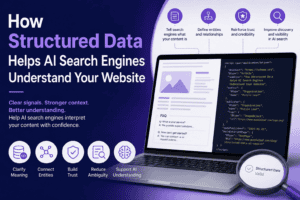
- Use structured data to help AI understand your content
- Build topical authority across related content pieces
- Showcase experience and trust (E-E-A-T)
- Create content in natural language, aligned with user intent
- Include FAQs, visuals, and summaries to support AI extraction
What is still the same?
- Your website still needs to be fast, mobile-optimized, and SEO friendly (crawlable)
- Backlinks still contribute to authority and credibility
- Metadata (Your Sitemap!) helps search engines understand your content contextually
- Domain authority and topical relevance still influence traditional search rankings
- Keywords still matter — but they get longer. Users still scroll down to explore websites for context, credibility, and options.
- Long form content is in! It may even perform better — especially when it’s original and experience-based.
- E-E-A-T (Experience, Expertise, Authoritativeness, Trust) remains critical for search ranking
- Optimizing for user intent, not just traffic, is still key to conversions.
- Internal linking and good site architecture continue to aid discoverability
- Google is still prioritizing “hidden gems” — personal blogs, expert commentary, and niche content that shows experience
What has changed?
- AI Overviews are now the first result for millions of searches. In simple terms, summaries trump website links
- Users increasingly get answers directly on the search page without opening the websites – your google analytics is going to change
- Metadata would additionally be read by AI crawlers to showcase content in AI summaries and search engineers
- AI citations also take domain authority and topical relevance into account
- Keywords now become more and more customized to natural language, with long-tail variations and search intent.
- E-E-A-T (Experience, Expertise, Authoritativeness, Trust) remains critical for AI trustworthiness.
- Google’s AI now pulls information from multiple sources synthesizing into one single response citing some (but not all) sources or references.
- Being referenced in AI-generated responses is now a new visibility battleground – which is increasing day by day
- New types of search inputs are rising: people are searching with voice, screenshots, photos, and even videos. Your content must adapt to be accessible and relevant
- Topical depth and authority on a specific theme (not just individual pages) are increasingly rewarded — especially for AI-powered overviews
- Generative AI results are rejuvenating older, well-structured, high-quality content — evergreen content now has greater ROI than ever for longer!
- AEO (Answer Engine Optimization) emerges as the future of SEO — focusing not just on ranking, but on being cited and summarized in AI responses.
As a business owner, what changes do you need to make?
- Create Clear, Direct Answers: Write content that caters to AI based searches.
- Build Topical Authority: Cover a subject in-depth across multiple related articles or pages
- Optimize for AEO + SEO Together: Use conversational tones and natural language while also using relevant keywords and structured data (SEO).
- Add structured data: Use different types of content – FAQ, How-To-Guides, Products, and Article to help AI and search engines interpret your content accurately.
- Include Original, Experience-Based Content: Create experience rich content like personal stories, expert tips, and real-world experience
- Use Visuals that Support Multimodal Search: Add relevant images, diagrams, and short-form videos to your website and content pages
- Make Evergreen Content Shine: Update and re-optimize high-quality older posts. Evergreen, well-structured content is being picked up more and more in AI answers.
- Use FAQs: AI loves clean, scannable formats. Add FAQ sections to increase the chance of your content being quoted.
- Track AI Visibility: Monitor whether your site is being cited in AI overviews using tools like Search Console and manual checks.
- Optimize all your pages: Apply AEO to product pages, help articles, landing pages, and even case studies. Anywhere users may ask questions, optimize for AI responses.
Wondering where to start?
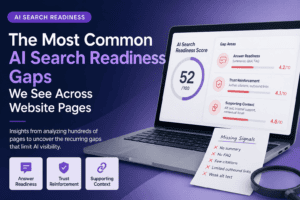
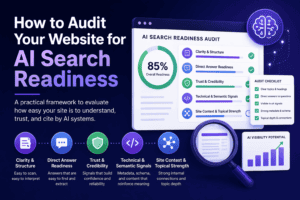
Try the Purple Leaf AI-Readiness Score Checker.
The tool is designed to help you evaluate your website’s preparedness for appearing in and competing for AI citations. It assesses various aspects of your website, including those highlighted above such as keyword proficiency, rich content, structured data, metadata clarity for crawlers and more. By identifying strengths and areas for improvement, the tool helps you develop a targeted strategy for successfully developing AI visibility.

In short, it will tell you where to stand and what to focus on to get your site AEO ready.
Common Questions
Question: What is Search 2.0?
Answer: Search 2.0 is a more conversational way of searching where AI answers questions directly instead of returning only blue links. It works more like a smart assistant, and it can use text, screenshots, photos, voice, and video to respond in a more user-friendly format.
Question: How is Search 2.0 different from traditional search?
Answer: Traditional search is keyword-based and usually returns ranked links for you to review. Search 2.0 is intent-driven and conversational, with AI-generated answer summaries, source citations, and follow-up questions. It also supports multimodal inputs like voice, images, screenshots, and video.
Question: What are AI Overviews in Google Search?
Answer: AI Overviews are concise AI-generated summaries that appear at the top of Google Search results. They are designed to answer the query directly and can cite relevant websites as sources, which changes how visibility and traffic work in search.
Question: Why do AI Overviews matter for websites?
Answer: They matter because users may get the answer without opening a website, so visibility now depends on being cited in the summary. That makes clear, trustworthy, and well-structured content more important for earning attention in AI-driven search.
Question: What is AEO?
Answer: AEO, or Answer Engine Optimization, is the next evolution of SEO. It focuses on making content easy for AI-driven search tools like Google’s AI Overviews, ChatGPT, and other AI search engines to cite or summarize in answers.
Question: How is AEO different from SEO?
Answer: SEO focuses on ranking for clicks, while AEO focuses on visibility in AI-generated answers. The goal shifts from getting users to click a link to getting your content cited or summarized directly in the response.
Question: What should businesses do to get ready for AI search?
Answer: Businesses should create clear answers, build topical authority, use structured data, and publish original experience-based content. The article also recommends visuals, FAQs, evergreen updates, AI visibility tracking, and optimizing product pages, help articles, landing pages, and case studies.
Question: Why should content answer questions clearly and upfront?
Answer: Clear, direct answers help AI understand the content faster and make it easier to cite. The article recommends writing in natural language that matches user intent and supports AI extraction with summaries, FAQs, and structured formats.
Question: Does structured data still matter for AI search?
Answer: Yes. Structured data helps AI and search engines interpret content more accurately, and the article specifically recommends using formats like FAQ, How-To, Products, and Article schema to support AI understanding.
Question: What content formats work well for AI visibility?
Answer: FAQs, TL;DRs, step-by-step guides, and other structured formats work well because they are easy for AI to extract and summarize. The article also says long-form content can perform well when it is original, experience-based, and well structured.
Question: What still matters in search even with AI?
Answer: Fast, mobile-optimized, crawlable websites still matter, along with backlinks, metadata, domain authority, topical relevance, and E-E-A-T. The article also says internal linking and good site architecture continue to help discoverability.
Question: Should businesses still care about keywords?
Answer: Yes, but keywords are becoming longer and more conversational. The article says users now search with natural language and intent-driven queries, so keyword strategy needs to reflect how people actually ask questions.
Question: How can a website improve its chances of being cited in AI answers?
Answer: A website can improve its chances by creating clear answers, using structured data, building topical depth, and showing experience and trust. The article also recommends evergreen updates, visuals, and content that matches user intent closely.
Question: What is the AI-Readiness Score Checker?
Answer: The AI-Readiness Score Checker is a Purple Leaf tool that helps evaluate how prepared a website is to appear in and compete for AI citations. It assesses areas such as keyword proficiency, rich content, structured data, and metadata clarity.
Question: What does the AI-Readiness Score Checker help identify?
Answer: It helps identify strengths and areas for improvement so you can build a targeted strategy for AI visibility. The article says it evaluates factors like keyword proficiency, rich content, structured data, and metadata clarity for crawlers.
Question: Where should AEO be applied on a website?
Answer: AEO should be applied across product pages, help articles, landing pages, and case studies. The article says any page where users may ask questions can be optimized for AI responses.
Question: Why are FAQs useful for AI search?
Answer: FAQs are useful because AI likes clean, scannable formats that are easy to quote and summarize. The article recommends adding FAQ sections to increase the chance that content is picked up in AI answers.
Question: What role does topical authority play in AI search?
Answer: Topical authority helps because AI systems increasingly reward depth across a theme, not just a single page. The article recommends covering a subject in depth across multiple related articles or pages.
Question: Can older content still perform well in AI search?
Answer: Yes. The article says evergreen, well-structured, high-quality older content can be rejuvenated by generative AI and may deliver stronger long-term ROI when it is updated and re-optimized.
Question: What search inputs are becoming more common?
Answer: Voice, screenshots, photos, and video are becoming more common search inputs. The article says content should adapt so it remains accessible and relevant across these multimodal formats.