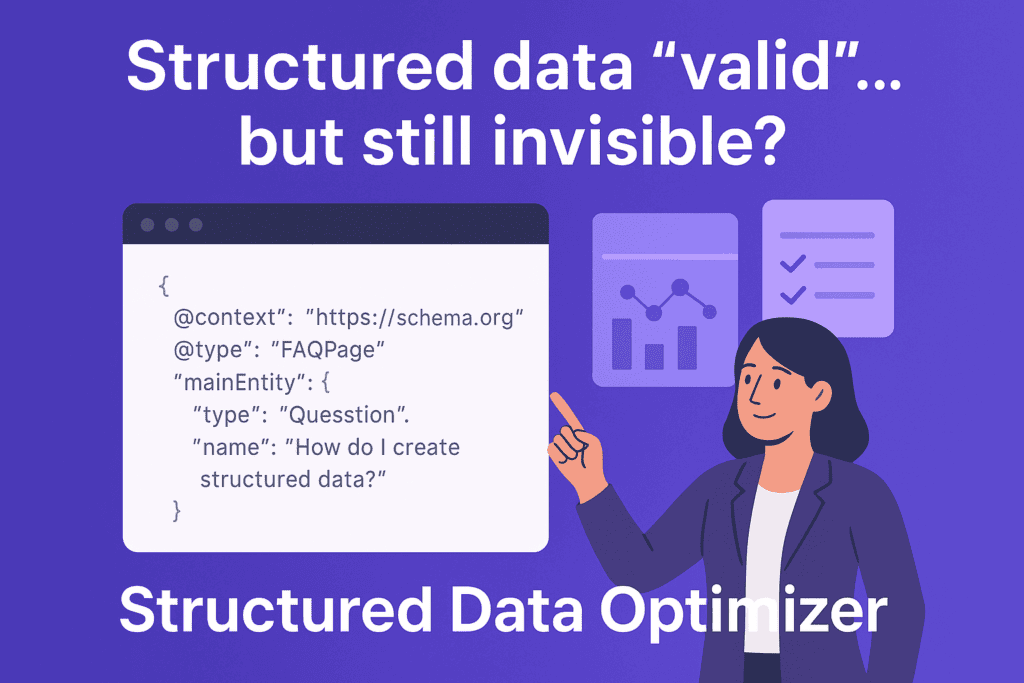
Structured data has quietly become one of the most important layers of modern SEO. It influences how search engines display your content, how AI systems interpret your pages, and whether your site is even eligible for rich results, snippets, or AI-generated answers.
Yet most websites still treat structured data as a checkbox exercise: add a schema, validate it, move on.
That approach no longer works.
The Structured Data Optimizer is built to solve few problems:
- Deeply analyze existing structured data (if present) for technical and contextual correctness
- Generate structured data that is not only technically valid but also strategically valid aligning with the content of the page
What Is Structured Data?
Structured data is a standardized way of explaining your content to search engines and AI Systems, using formats like JSON-LD. Instead of forcing search engines and AI systems to infer meaning from raw text, structured data clearly states:
- What the page represents
- Who the provider or publisher is
- How different elements on the page relate to each other
Structured data powers:
- FAQ rich results
- Enhanced search listings
- Snippets and answer boxes
- AI Overviews and answer engines
The Real Problem With Most Structured Data Implementations
Most sites don’t lack structured data. They lack the right structured data.
Common issues include:
- Using only one schema type (usually FAQPage)
- Schema that doesn’t describe the actual offering (service, software, tool)
- Missing or weak organization and publisher signals
- No clear entity relationships
- Valid JSON-LD that doesn’t match the page’s real intent
The result?
Search engines can read your schema, but they don’t fully understand your page.
This is exactly the gap the Structured Data Optimizer is designed to fill.
What the Structured Data Optimizer Does
The Structured Data Optimizer goes beyond validation. Instead of simply checking whether the schema is “correct,” it evaluates how effective your structured data actually is.
Our structured data optimizer tool:
- Audits existing structured data on a page
- Scores it across multiple quality dimensions
- Identifies gaps, conflicts, and missing entities
- Explains what’s holding your schema back
- Generates optimized, ready-to-use JSON-LD aligned with the page content
Based on the analysis, the optimizer produces:
- Optimized FAQPage schema
- Service or SoftwareApplication schema
- Organization schema where needed
These JSON-LD blocks are:
- Copy-paste ready
- Aligned with visible content
- Designed to work together as a coherent schema graph
This removes the need for manual schema writing or trial-and-error testing.
The 8 Core Evaluation Areas
The Structured Data Optimizer evaluates schema across eight practical areas that directly affect understanding and visibility:
- Schema Coverage – AI systems rely on appropriate schema types to understand page intent and content structure.
- Entity Alignment – Correct entity representation helps AI systems accurately interpret what the page is about.
- Technical Validity – Valid, parsable structured data ensures AI systems can process and understand your content.
- Content Consistency – Consistent schema values build trust and ensure AI systems interpret content correctly.
- Property Completeness – Complete properties provide richer signals to AI systems, improving understanding and trust.
- Redundancy and Conflicts – Clean, conflict-free schema reduces ambiguity and improves AI system interpretation.
- Entity Linking and References – Proper linking and references help AI systems establish entity identity and trust.
- Graph Structure & Relationships – Proper entity relationships help AI systems understand connections and context.
Why Structured Data Matters for AI Search
AI systems don’t interpret web pages the same way people do. They rely on structured signals to understand what a page represents, who it’s about, and how different pieces of information are connected. Clear structured data reduces confusion and helps AI systems process content accurately.
Conclusion: Structured Data is the Growth Factor
Having a schema in place is only the first step. What matters is whether it clearly reflects what your page offers and how different elements are connected.
The Structured Data Optimizer helps you review, improve, or create structured data so search engines and AI systems can understand your pages more accurately.
Purple Leaf makes this process straightforward, without relying on manual checks or custom schema work.