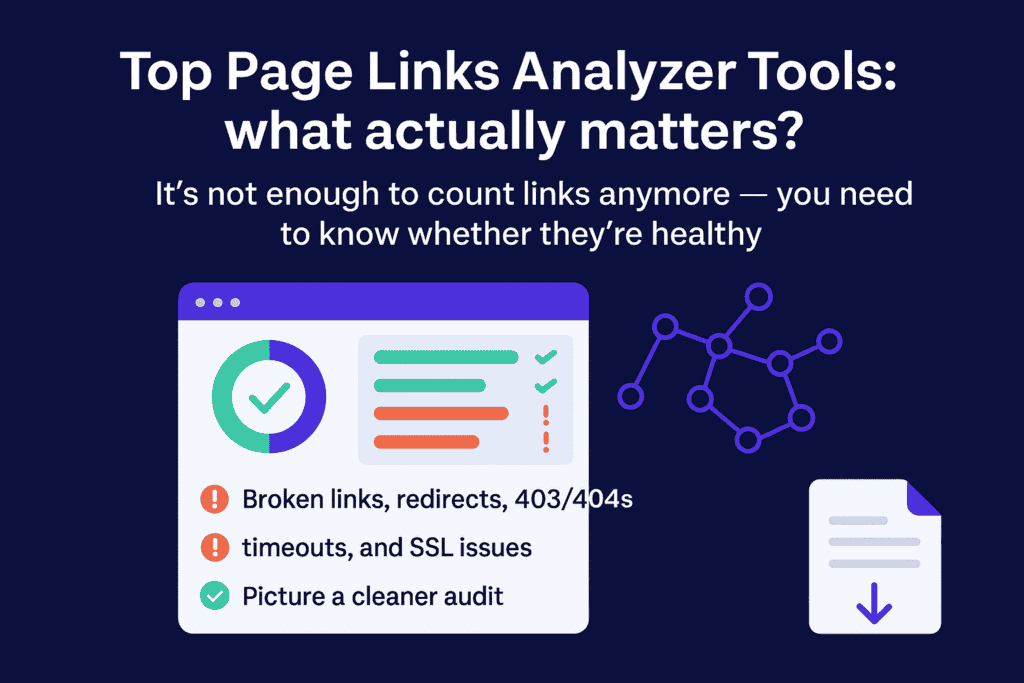
In today’s SEO landscape, simply creating content isn’t enough.
What truly impacts rankings (and user experience) is how well your links are structured, maintained, and optimized.
Broken links, poor internal linking, and unmonitored external links can quietly damage your SEO performance. That’s where page links analyzer tools come in. But not all tools are built the same. Some only count links. Others focus on structure. Very few actually help you identify issues and fix them.
In this guide, we will compare the top page links analyzer tools and show which one truly stands out.
Top Page Links Analyzer Tools
1. Purple Leaf
Purple Leaf analyzes links at a page level and focuses on identifying both structure and underlying issues that can impact SEO and user experience.
What it detects
Instead of just listing links, it highlights actual issues such as:
- Broken or missing pages (404s)
- Access blocked (403 / 401 errors)
- Server failures (5xx errors)
- Redirects
- Too many redirects / redirect loops
- Timeouts
- DNS failures
- SSL / security errors
These are the kinds of issues that often go unnoticed but can directly affect performance and crawlability.
What it offers
- Clear separation of good links vs issues
- Easy-to-understand breakdown of link health
- Visibility into what needs attention
- Downloadable reports for further analysis
2. Small SEO Tools
A simple and widely used tool for quickly checking links on a page.
What it shows:
- Internal vs external links
- Dofollow vs nofollow
- Total link count
Where it works well:
Good for getting a quick snapshot of a page.
Limitations:
It focuses more on listing links than identifying issues, so interpretation is still manual.
3. Linksman
A lightweight tool designed for fast and straightforward link analysis.
What it offers:
- Internal vs external link breakdown
- Follow vs nofollow classification
Where it works well:
Useful for quick audits and understanding link distribution.
Limitations:
Does not highlight errors or provide guidance on what to fix.
4. SEO Review Tools
This tool focuses primarily on internal linking.
What it offers:
- Crawlable internal links
- Insights into internal link structure
Where it works well:
Helpful when optimizing internal linking strategies.
Limitations:
Doesn’t provide a full-page view and lacks issue detection.
5. Sitechecker
A tool focused on analyzing outbound (external) links.
What it offers:
- External link tracking
- Insights into outbound links
Where it works well:
Useful for reviewing outgoing links.
Limitations:
Doesn’t combine internal and external link analysis into one view.
Comparison Table
| Tool | Internal Links | External Links | Link Classification | Error Detection | Actionable Insights |
| Purple Leaf | ✅ | ✅ | ✅ | ✅ | ✅ |
| Small SEO Tools | ✅ | ✅ | ✅ | ❌ | ❌ |
| Linksman | ✅ | ✅ | ✅ | ❌ | ❌ |
| SEO Review Tools | ✅ | ❌ | ❌ | ❌ | ❌ |
| Sitechecker | ❌ | ✅ | ❌ | ⚠️ Limited | ❌ |
Wrapping It Up
Each of these tools is useful in its own way, some for quick checks, others for understanding structure.
But once you go beyond basic analysis, it’s not just about how many links exist. It’s about whether those links are actually working as they should.
That’s where tools like Purple Leaf come in, combining link analysis with issue detection to make the insights more actionable.