As AI-powered search experiences become more common, website owners are asking a new question:
What actually makes a page ready to be understood, trusted, and cited by AI?
That question matters because visibility is changing. It is no longer only about ranking in search results. Increasingly, it is also about whether AI systems can interpret your content clearly enough to use it in answers.
To better understand that shift, we reviewed hundreds of pages that had been analyzed using Purple Leaf’s AI Search Readiness framework.
What we found was not a story of widespread failure.
It was a story of partial readiness.
Many pages already show signs of a solid SEO and technical foundation. But many are still missing the additional signals that make content easier for AI systems to summarize, trust, and cite.
That gap is important because it helps explain why a page can still look “fine” by traditional standards, yet remain less visible in AI-powered discovery.
Most pages are not failing outright. They are landing in the middle.
One of the clearest patterns in the data was that most pages were neither excellent nor broken.
They tended to fall in the middle.
That is an important starting point, because it changes the story.
If most pages were scoring at the bottom, the takeaway would be that websites need major structural repair. But that is not what this data suggests.
Instead, many pages appear to have a workable foundation. They are doing some important things right. At the same time, they are not yet consistently strong enough in the areas that support AI visibility.
In practical terms, that means many site owners may not need a full rebuild.
They may need targeted improvements in the right places.
That is a much more useful conclusion than assuming every site needs to start over.
Overall summary metrics
| Average Score | Median Score | 25th Percentile | 75th Percentile |
| 60.6 | 62.9 | 52.6 | 70.5 |
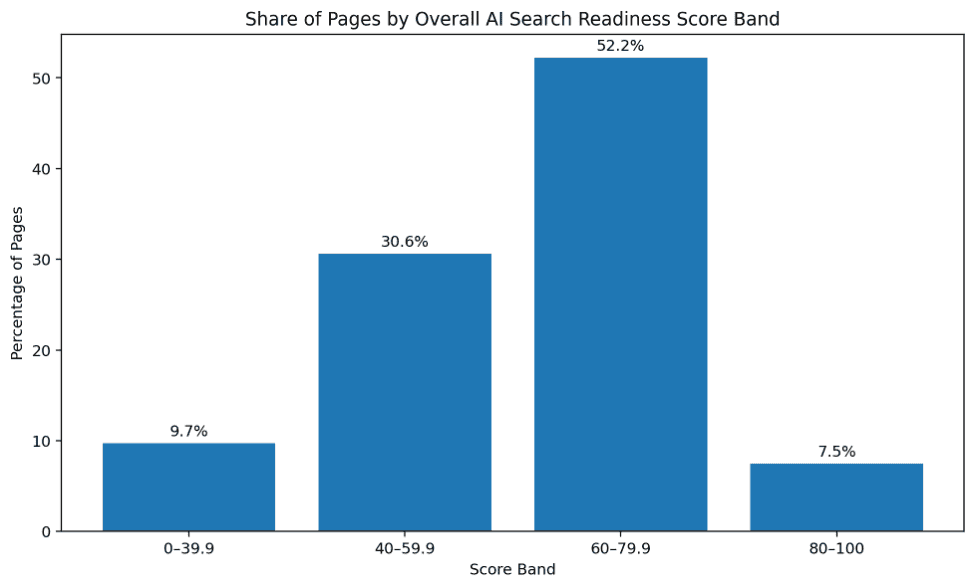
Distribution of pages by overall AI Search Readiness score band
| Score Band | % of Pages |
| 0–39.9 | 9.7% |
| 40–59.9 | 30.6% |
| 60–79.9 | 52.2% |
| 80–100 | 7.5% |
Most pages fell into the middle bands rather than the extremes. That reinforces the idea that the average page is not broken, but also not fully AI-ready.
Many pages already have meaningful strengths
Another clear pattern in the data was that a lot of pages were already doing relatively well on several foundational signals.
Across the pages analyzed, recurring strengths often included clear organization identity, structured data implementation, strong entity salience, reasonable heading structure, and complete or well-formed meta tags.
That matters because it reinforces an important point: strong SEO still matters.
If you have already invested in clear site structure, metadata, internal organization, and content clarity, that work still counts. Those signals still help search engines and AI systems understand what your pages are about.
This is one reason AI Search Readiness should not be framed as a replacement for SEO.
It builds on the same foundation.
The challenge is that a solid foundation does not automatically make a page ready for AI-powered search experiences.
A page can still be technically decent and structurally sound, but remain weaker in the areas that help AI systems extract, support, and confidently reuse its content.
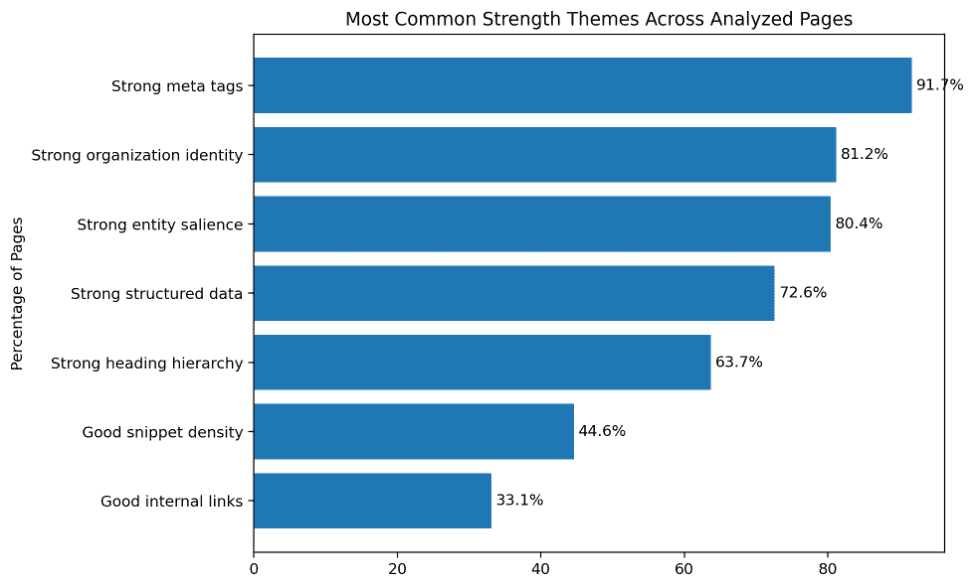
Most common recurring strength themes
| Strength Theme | % of Pages |
| Strong meta tags | 91.7% |
| Strong organization identity | 81.2% |
| Strong entity salience | 80.4% |
| Strong structured data | 72.6% |
| Strong heading hierarchy | 63.7% |
| Good snippet density | 44.6% |
| Good internal links | 33.1% |
The strength table points to a clear pattern: many pages already have meaningful technical and structural groundwork in place. That is why this dataset supports a “build on the foundation” message rather than a “start over” message
The biggest gaps are often about answer readiness and trust support
If the strengths in the data reflect foundation, the weaknesses reflect the missing layer.
Across the pages analyzed, some recurring gaps appeared again and again.
These included missing TL;DR-style summaries near the top of the page, missing Q&A or FAQ-style content, weak author, citation, or visible trust signals, limited authoritative outbound support, weak or inconsistent alt text on key images, and shallow contextual support around content.
What is interesting is that many of these are not the kinds of issues site owners usually think about first.
They are not always obvious technical failures.
They are often missing signals of clarity, support, and trust.
That distinction matters.
A page does not have to be broken to be less useful to AI systems. It may simply be missing the kind of structure and reinforcement that makes it easier to summarize and cite.
For example, if an important answer is buried deep in a long page, or if a service page has no FAQ-style content, no concise summary, and no visible support for its claims, the page may still rank reasonably well in search.
But it may be less likely to be used confidently in AI-generated answers.
That is the difference between being searchable and being readily usable.
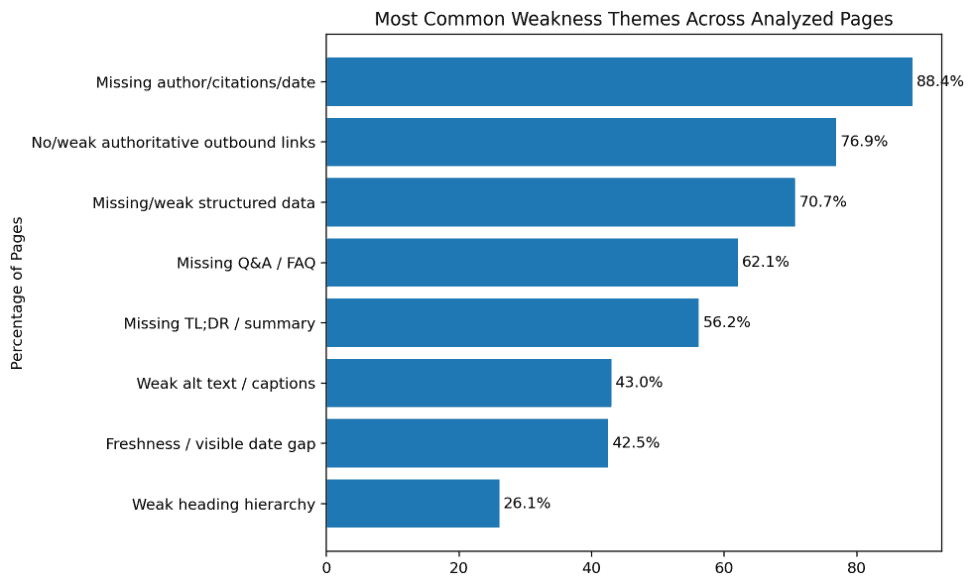
Most common recurring weakness themes
| Weakness Theme | % of Pages |
| Missing author/citations/date | 88.4% |
| No/weak authoritative outbound links | 76.9% |
| Missing/weak structured data | 70.7% |
| Missing Q&A / FAQ | 62.1% |
| Missing TL;DR / summary | 56.2% |
| Weak alt text / captions | 43.0% |
| Freshness / visible date gap | 42.5% |
| Weak heading hierarchy | 26.1% |
The recurring weaknesses are notable because many of them are not catastrophic technical failures. They are missing layers of answer readiness, support, and trust that can quietly hold pages back in AI-driven discovery.
Strong SEO does not automatically equal AI Search Readiness
This was probably the most important overall takeaway.
Many pages in the dataset looked reasonably strong on classic SEO and technical signals, but much less consistent on the content and trust signals that support AI visibility.
That means the next gap for many websites is not always basic SEO.
It is often the layer beyond that.
A page may already have decent metadata, good entity clarity, some structured data, and acceptable heading structure.
But it may still lack a concise summary, answer-oriented content, trust reinforcement, supporting citations, and stronger contextual support around its main ideas.
That does not mean SEO work has lost its value.
It means the definition of visibility is expanding.
Traditional SEO helps a page get discovered and ranked.
AI Search Readiness helps a page become easier to understand, summarize, trust, and cite.
Those two things are connected, but they are not identical.
What website owners should take away from this
There are a few practical lessons here.
1. Do not assume your site is in bad shape just because it is not appearing in AI answers. A lot of pages already have useful strengths.
2. Do not assume solid SEO means the job is done. Good structure and metadata still matter, but they may not be enough on their own.
3. Look for the missing layer. In many cases, the biggest opportunities are not dramatic overhauls. They are targeted improvements such as adding concise summaries, expanding Q&A coverage, strengthening trust signals, improving contextual support, and reinforcing content with clearer structure and supporting detail.
4. Focus on page-level visibility, not just site-wide assumptions. The gap is often uneven. Some pages may be much stronger than others.
That is why page-level analysis matters.
Without it, it is difficult to know whether the issue is weak structure, weak support, weak trust reinforcement, or a combination of smaller gaps.
The real takeaway: many pages are not broken. They are incomplete.
That is the simplest way to describe what we saw.
Across the pages analyzed, many already showed a decent technical and SEO foundation. But many were still missing the signals that make content easier for AI systems to use well.
That is an important distinction.
Because if the problem were total failure, the answer would be to rebuild everything.
But if the problem is incompleteness, the answer is more practical: identify the missing layer, fix what matters most, and improve from there.
That is exactly what AI Search Readiness is meant to help uncover.
Want to see where your pages stand?
Purple Leaf helps you identify the issues that may be reducing your visibility in AI-powered search experiences.
Scan your website to see where your pages are strong, where they are falling short, and what to fix first.