Last month, a potential customer typed this into ChatGPT: “What are the best bookkeeping services for small businesses in Austin?”
ChatGPT responded with three specific companies. It named them by name. It explained what each one does well. It cited sources.
None of those three companies were ranked #1 on Google. One of them didn’t even rank on page one. But all three were cited because their websites were structured in a way that made them easy for AI to read, trust, and quote.
That is GEO — Generative Engine Optimization.
Right now, most small business owners and independent websites have never heard of it.
By the time you finish reading, you’ll understand what GEO is, why it matters more than almost any SEO tactic you’re currently using, and five specific things you can do this week to start showing up in AI-generated answers — with zero budget required.
What Is Generative Engine Optimization (GEO) and how it is different from SEO?
Generative Engine Optimization (GEO) is the practice of structuring your website and content so that AI-powered platforms — like ChatGPT, Perplexity, Google AI Overviews, and Gemini — cite your site when generating answers to users’ questions.
Where traditional SEO gets you ranked in a list of blue links, GEO gets you quoted inside the answer itself. You’re not competing for a position on a results page. You’re competing to be the source that the AI selects, trusts, and cites when someone asks a question relevant to your business.
GEO in One Sentence
GEO is the practice of making your content easy for AI search engines to find, extract, and quote — so your website becomes the answer, not just a result.
That’s the definition. Everything else in this guide is the practical “how.”
Quick Glossary: 8 Generative Engines Terms You Need to Know
Before going further, here are eight terms that come up constantly in GEO. If you’ve ever felt lost reading about AI search, this table is your decoder ring.
| Term | What It Means in Plain English |
|---|---|
| Generative Engine | An AI tool that creates answers (like ChatGPT or Google AI Overviews) rather than just listing links |
| Citation | When an AI mentions your website as a source inside its answer — the equivalent of a #1 ranking in traditional search |
| RAG | Retrieval-Augmented Generation — the process AI uses to pull real web content before writing a response. It reads sources, then synthesizes an answer |
| Entity | A clearly defined person, place, product, or concept that AI can recognize and categorize (e.g., “Austin bookkeeper” or “freelance graphic designer”) |
| Semantic Chunk | A self-contained paragraph that makes sense on its own, without needing surrounding context — the unit AI systems prefer to cite |
| AI Overview | Google’s feature that shows an AI-generated summary at the top of search results, now appearing on over 57% of all Google searches |
| LLM | Large Language Model — the AI technology powering tools like ChatGPT, Claude, and Gemini |
| Citation Decay | The gradual process by which AI platforms stop citing older content in favor of fresher, more recently updated sources |
You’ll see every one of these terms again before this article is over. Now that you know what they mean, they won’t slow you down.
GEO vs. SEO — What’s Actually Different?
This is the question everyone asks first, and it’s the right place to start. SEO and GEO are not enemies. They’re not the same thing either. They’re two different disciplines targeting two different goals — and you need both.
What SEO Optimizes For
Traditional SEO optimizes for clicks from a ranked list. The goal is to appear on page one of Google’s search results when someone searches a keyword. The success metric is your ranking position and the traffic that comes from people clicking your link. SEO rewards pages that comprehensively cover a topic, earn backlinks from authoritative sites, load quickly, and use keywords strategically. It’s been the foundation of content marketing for 25 years — and it still matters.
What Generative Engine Optimization is
GEO optimizes for citations inside AI-generated answers. The goal is to be the source an AI selects when synthesizing a response. The success metric isn’t a ranking position — it’s whether your name, your content, or your URL shows up in the answer itself.
GEO rewards content that is clearly structured, self-contained, precisely written, factually cited, and easy for an AI to extract and reuse. A page can rank #1 in Google and never be cited by ChatGPT if it’s written in a way that AI can’t parse. Conversely, a page with modest Google rankings can become a frequently cited AI source if it’s structured correctly.
| Factor | Traditional SEO | GEO |
|---|---|---|
| Goal | Rank on page 1 | Get cited in AI answers |
| Success metric | Click-through rate | Citation frequency |
| Unit of optimization | The full page | Individual paragraphs (chunks) |
| Key signals | Backlinks, keywords, page authority | Entity clarity, structured data, E-E-A-T |
| Content format | Long-form comprehensive coverage | Self-contained, extractable sections |
| Freshness factor | Important | Critical — 50% of AI citations are <13 weeks old |
| Measurement | Google Search Console | AI platform prompting + monitoring tools |
Do You Have to Choose?
No — and this is the reassuring part. Good SEO is the foundation that GEO builds on. AI platforms like ChatGPT and Perplexity pull from web indexes (primarily Google and Bing) to find candidate sources. If you’re not indexed and ranking at least somewhat in traditional search, AI platforms may not even find your content to consider citing it. GEO is the layer you add on top. The work you’ve already done on SEO isn’t wasted — it just needs a new layer of optimization to convert your search visibility into AI citations.
Why GEO Important Right Now — The Numbers You Can’t Ignore
If you’re thinking “this sounds like future stuff,” here is what’s already happening — right now, in 2026.
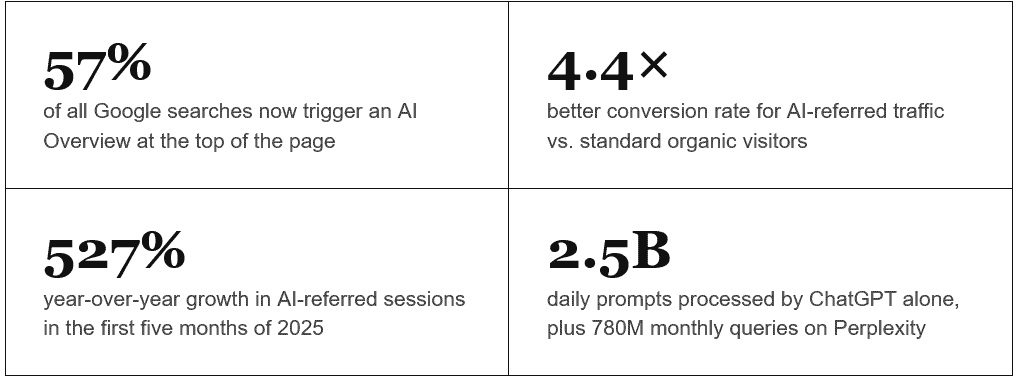
And here’s the opportunity: most small business websites have done nothing to optimize for AI search. The businesses getting cited today are not necessarily the biggest or best — they’re the ones that got there first and structured their content correctly.
How Do AI Search Engines Actually Choose What to Cite?
This is the part most GEO guides skip over or bury in technical jargon. Let’s make it concrete. When someone asks ChatGPT or Perplexity a question, the AI doesn’t just make up an answer from its training data. It actively retrieves real web content to inform its response. Here’s how that process works in three steps.
Step 1 — The AI Retrieves Candidate Sources
Think of the AI as a very fast, very thorough researcher. When you submit a query, it scans thousands of indexed web pages relevant to that topic within milliseconds. This retrieval process is powered by RAG — Retrieval-Augmented Generation. RAG means the AI doesn’t rely only on what it “memorized” during training. It actively goes out and reads current web content before writing its answer.
The key takeaway: if your site is indexed and your content is relevant to a query, your page is in the pool of candidates. You just need to be the best candidate in that pool.
Step 2 — The AI Evaluates Source Quality
Once the AI has a pool of candidate sources, it evaluates them. The signals it weighs include:
- E-E-A-T — Experience, Expertise, Authoritativeness, Trustworthiness. Google’s quality framework, adopted by AI systems as a proxy for reliability.
- Site authority — Domain age, inbound links, and brand recognition.
- Recency — When the content was last updated. Fresher content is strongly preferred for factual topics.
- Structured data — Schema markup that explicitly tells AI what your page is about.
- Content extractability — How easy is it to pull a self-contained answer from your page?
Step 3 — The AI Selects Citable Chunks
Here’s the detail that changes everything: AI doesn’t cite pages — it cites paragraphs.
When an AI generates an answer, it identifies specific sections of your content that directly address the query. It extracts those sections — those “chunks” — and synthesizes them into the response. If your key paragraph requires three surrounding paragraphs to make sense, the AI will skip it. If your paragraph stands alone as a clear, direct answer, it becomes a prime citation target. Your job is to make every important paragraph in your content a self-contained, citable chunk.
5 GEO Tactics That Work for Small Sites (No Budget Required)
These five tactics can be applied to any existing page on your site today. No tools, no agency, no technical background required.
Tactic 1: Write Answer-First Paragraphs
Most web content buries the answer. The opening paragraph sets the scene, explains the context, previews what’s coming — and only gets to the actual answer several paragraphs in. AI systems don’t wait. They look for the most direct, clearly written answer to a query. If yours isn’t near the top, you lose the citation to someone whose answer is.
The fix is a writing pattern called BLUF — Bottom Line Up Front. Instead of building to the answer, you lead with it.
| Before GEO | After GEO |
| “Invoice financing is a topic that comes up a lot when small business owners are struggling with cash flow. There are many different options available, and it can be hard to know where to start. In this post, we’re going to explore what invoice financing is, how it works, and whether it might be right for your business.” | “Invoice financing is a funding method where a business sells its unpaid invoices to a lender in exchange for immediate cash — typically 80–90% of the invoice value upfront. It solves the common problem of waiting 30–90 days for clients to pay while still needing to cover payroll, inventory, or operating costs.” |
The second version answers the question in the first sentence. An AI reading both versions will extract the second one almost every time. Apply this pattern to every major section of your best-performing pages — rewrite the opening sentence of each H2 section so it directly answers the implied question of that heading.
Tactic 2: Add Statistics and Citations
AI systems treat sourced claims as a trust signal. When you write “According to the U.S. Bureau of Labor Statistics, the average small business spends 8% of annual revenue on marketing,” that attribution tells the AI your content is factually grounded, not just opinion.
Unsourced claims — “most businesses struggle with cash flow” — carry less weight because AI can’t verify them. Sourced claims give the AI something concrete to work with and something credible to cite.
Practical rule: every statistic in your content should have a named source. Government datasets (BLS, Census Bureau, SBA), major trade publications, annual industry reports, and well-known research firms (McKinsey, Gartner, Forrester) all qualify. Free reports from tools your audience uses — HubSpot, QuickBooks, Shopify — are excellent citations and easy to link to.
Tactic 3: Optimize Your Entities, Not Just Your Keywords
Traditional SEO optimizes for keywords — specific phrases people type into Google. GEO goes one level deeper and optimizes for entities — the clearly defined people, places, products, organizations, and concepts that AI systems use to understand what your content is really about.
To optimize for entities, be explicit. Don’t say “our tool helps with this.” Say “our CRM software helps B2B sales teams track leads and automate follow-up emails.” The more specific and unambiguous your language, the better the AI understands what you’re talking about — and the more likely it is to serve your content to queries that match those entities.
Tactic 4: Add FAQ Blocks With Schema Markup
Question-and-answer format naturally aligns with how AI processes queries. When you include a FAQ section — especially one marked up with FAQ schema — you’re directly signaling that this content answers specific queries. FAQ schema doesn’t require a developer. WordPress plugins like Rank Math and Yoast both handle it with a few clicks. If you manage your site manually, here’s the basic template:
{
  "@context": "https://schema.org",
  "@type": "FAQPage",
  "mainEntity": [{
    "@type": "Question",
    "name": "What is GEO (Generative Engine Optimization)?",
    "acceptedAnswer": {
      "@type": "Answer",
      "text": "GEO is the practice of structuring your content so that AI-powered
platforms like ChatGPT, Perplexity, and Google AI Overviews cite your
website when generating answers to user questions."
    }
  }]
}
Add 3–5 genuine questions and answers per page — questions your actual customers ask, phrased the way they’d type them into a search bar or AI prompt. This single tactic is one of the highest-leverage, lowest-effort changes you can make to an existing page.
Tactic 5: Keep Your Top Pages Fresh
AI platforms re-evaluate their citation sources regularly — and they heavily favor recently updated content. Research from Seer Interactive found that 50% of the content cited in AI-generated answers was less than 13 weeks old at the time of citation. This doesn’t mean rewriting your entire article every three months. It means:
- Updating your statistics — replace any data point older than 12–18 months
- Adding a visible “Last Updated” date at the top of the article
- Adding a new example, case study, or tool recommendation when something relevant changes
- Reviewing your FAQ block — remove outdated questions, add new ones that have emerged recently
Set a quarterly calendar reminder to review your five most important pages. A 30-minute update to each can meaningfully extend their AI citation lifespan.
GEO vs. AEO — Are They the Same Thing?
If you’ve been researching this topic, you’ve probably seen both “GEO” and “AEO” (Answer Engine Optimization) used interchangeably — and then seen other sources insist they’re completely different things. Here’s the clear answer.
GEO is the broader term. It covers optimization for all generative AI platforms — ChatGPT, Perplexity, Google AI Overviews, Gemini, and any future AI search tool. GEO is the 2025–2026 framing of the discipline.
AEO is an older term that originally referred to optimizing for featured snippets and voice search assistants like Siri and Alexa. In 2026, AEO has expanded and now largely overlaps with GEO in tactics and intent. Most practitioners use the two terms interchangeably.
For practical purposes: the tactics that achieve GEO also achieve AEO. You don’t need to run two separate strategies. Focus on the outcome — being cited by AI when users ask questions relevant to your business. Want the full breakdown? We cover it in detail in What Is AEO (Answer Engine Optimization)? — including the 14-parameter checklist you can use to audit any page on your site.
Is Your Content GEO-Ready? Run a Quick Self-Check
Before spending time on new GEO tactics, it’s worth understanding where your existing content stands. Go to your most-visited page — your homepage, your top blog post, or your main service page — and work through the 10 items below.
- 1 Does the page answer a specific question in its very first paragraph?
- 2 Is there a visible author name with a brief bio or credentials?
- 3 Does the page cite at least two external sources with outbound links?
- 4 Does any section of the page have a FAQ block with at least 3 questions?
- 5 Is there a “Last Updated” date visible somewhere on the page?
- 6 Do your H2 and H3 headings read as questions or clear answers — not just topic labels?
- 7 Can any single paragraph on this page be understood without reading the ones before it?
- 8 Does the page have schema markup (FAQ, Article, or Organization)?
- 9 Does the page load and render without JavaScript being required to see the main content?
- 10 Is your site accessible to AI crawlers — no GPTBot or PerplexityBot blocks in your robots.txt?
How to Interpret Your Score
- 8–10 checks Your page has a strong GEO foundation. Your next step is monitoring — track whether you’re being cited and by which platforms.
- 5–7 checks Moderate GEO readiness. Prioritize the unchecked items — FAQ schema, answer-first rewrites, and external citations tend to have the fastest impact.
- 0–4 checks Your page is likely invisible to AI search platforms regardless of its Google rankings. Start with checks 1, 4, and 8 — they deliver the most GEO lift per hour of work invested.
Tool Recommendation
Want a Full 14-Parameter GEO Audit — Automatically?
The 10-point check above covers the basics. A complete AI readiness audit goes deeper — checking entity salience, semantic heading hierarchy, snippet density, TL;DR summaries, content freshness, metadata completeness, and more. PurpleLeaf.ai runs this full audit automatically in about 60 seconds. It scores your page across 14 AEO/GEO parameters, shows exactly what’s missing, and gives you a prioritized action list. Individual page audits start at $1. Monthly monitoring plans start at $19.
How to Measure GEO Success
One of the most common questions about GEO is: “How do I know if it’s working?” Here’s how to track progress without a big tool budget.
The Free Method — Manual Prompting
Once a month, open ChatGPT, Perplexity, and Google with AI Overviews and type in the 5–7 questions your ideal customers are most likely to ask. Questions like: “What is the best [your service] for [your target customer]?” or “How do I [problem your product solves]?” Note whether your site is cited, your brand is mentioned, or any language from your pages appears in the response. Track this in a simple spreadsheet — date, platform, query, and whether you appeared. This manual method takes about 15 minutes per month and will tell you whether your GEO efforts are moving in the right direction.
Tracking AI Referral Traffic in Google Analytics
AI-cited traffic shows up in Google Analytics as referral traffic from specific domains. Set up a custom segment that filters for traffic from chatgpt.com, perplexity.ai, bing.com (which feeds ChatGPT Search), and gemini.google.com. This gives you a growing baseline to measure against month over month. Even modest numbers are meaningful, because AI-referred visitors convert at 4.4× the rate of standard organic traffic.
When to Expect Results
| Your Site’s Current State | Realistic Timeline for AI Citations |
|---|---|
| Strong domain authority + good existing SEO | 4–8 weeks after implementing tactics |
| Moderate authority, some SEO foundation | 8–16 weeks for consistent AI mentions |
| New site or low domain authority | 3–6 months; build SEO foundation first |
GEO is a compounding strategy. Every page you optimize becomes a long-term citation asset — as long as you keep it fresh.
Frequently Asked Questions About GEO
Question: Is GEO the same as SEO?
Answer: No. SEO focuses on ranking your pages in traditional search results — the blue links on Google. GEO focuses on getting your content cited inside AI-generated answers. They share some foundational signals (domain authority, E-E-A-T, good content), but GEO requires additional optimization for content structure, entity clarity, and answer-first formatting that traditional SEO doesn’t emphasize.
Question: How long does GEO take to work?
Answer: For established sites with decent SEO foundations, most practitioners see measurable movement in AI citations within 4–12 weeks of applying GEO tactics. For newer or lower-authority sites, expect 3–6 months. Freshness matters significantly — content you update today can enter AI citation pools within weeks if the other signals are in place.
Question: Is GEO free to implement?
Answer: For established sites with decent SEO foundations, most practitioners see measurable movement in AI citations within 4–12 weeks of applying GEO tactics. For newer or lower-authority sites, expect 3–6 months. Freshness matters significantly — content you update today can enter AI citation pools within weeks if the other signals are in place.
Question: What is a GEO audit?
Answer: A GEO audit is a structured review of your pages to evaluate how well they’re optimized for AI search citations. A thorough audit checks parameters like content structure, entity clarity, schema markup, author authority signals, content freshness, crawl accessibility, and more. You can run a basic audit manually using the 10-point checklist in this article, or use a tool like PurpleLeaf.ai to run a full 14-parameter audit automatically.
Question: Does GEO work for service businesses, not just content sites?
Answer: Yes — and it may actually be more impactful for service businesses than for content publishers. When someone asks ChatGPT “who are the best accountants in Denver for small businesses?” or “what should I look for in a personal injury attorney?”, the AI is looking for authoritative, structured content that answers that question. A well-optimized service page can absolutely get cited. The key is making sure your service pages answer questions, not just describe your offerings.
Your Next Steps
You now know what GEO is, how it works, and five tactics to start using today. Here’s how to turn this knowledge into action this week.
- Run the 10-point self-check on your most important page. Take your homepage or top blog post through the checklist above. Identify which of the 10 items you’re failing. That’s your priority list.
- Rewrite one opening paragraph using answer-first structure. Pick the page where you failed check #1. Rewrite that opening paragraph using the BLUF method — lead with the direct answer. This single change on a single page is the fastest GEO win available to you.
- Add a FAQ block to your top traffic page. Write 3–5 questions your customers actually ask. Write a direct, 40–60 word answer to each. Add FAQ schema using your WordPress plugin or the JSON-LD template above.
- Get a full audit to see the complete picture. The 10-point check reveals surface issues. A full 14-parameter audit shows you what’s missing at the level AI systems actually evaluate.
Start Here
Know Exactly Where You Stand — In 60 Seconds
The fastest way to understand your full GEO readiness is to run a proper audit. PurpleLeaf.ai checks your page across all 14 AEO/GEO parameters — structured data, entity clarity, snippet density, content freshness, author signals, metadata, and more — and gives you a clear, prioritized action list. No SEO expertise required. Monthly plans from $19.